Trusted by those who value real craftsmanship

Why Choose Farmhouse Cabinets?

Because it is the one style that improves with use. Every other kitchen is at its best on handover day and spends the next decade slowly losing ground. A farmhouse kitchen is drawn around hardwood with visible character and finishes with depth in them, so a scuff on a cabinet door reads as history rather than damage.

It is also the style that reaches furthest past the door. A plain square front is where it starts, and then the hood, the island and the finish decide whether the room lands. Get those three right and the cabinetry barely has to try. Get them wrong and no door style in the catalog will rescue it.

Character Is Hard to Photograph

The grain swings and color variation that make a farmhouse kitchen work are the first things a camera evens out. Order a $12 sample in hickory or oak and look at what the wood is actually doing before you commit a whole room to it.
Order a sample 
Kitchen Cabinets

Kitchen Cabinets

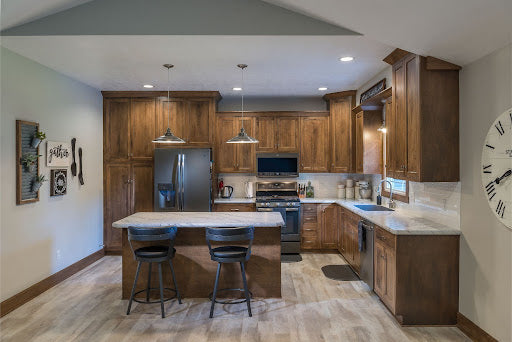
The hood is the decision. Nothing else in a farmhouse kitchen carries as much weight, because it sits at eye level above the range and sets the tone for every cabinet around it. We hold 98 of them, from flat panels and gentle curves through to shaped and scrolled fronts, in metal patinas and in wood to match your doors. Everything else follows from there. A quiet painted perimeter with a stained island, or one species running the whole way round, both work once the hood has told the room what it is.

View more →
Bathroom Vanities

Bathroom Vanities

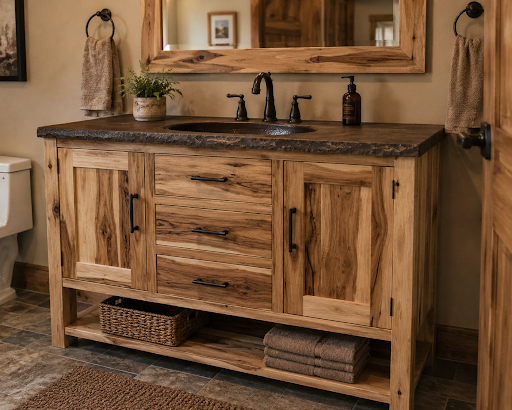
A farmhouse bathroom wants a piece of furniture with a sink in it. That means a vanity with its own proportions rather than a box pushed against a wall, and it is the one room where a second species or a contrasting paint does not look like an accident. Ours come with a Hanstone quartz top, an undermount porcelain basin and a four inch backsplash as standard, which gives the wood something hard and plain to sit under. We size them around what the room already has, from a powder room single up to a double.

View more →
Laundry and Utility Cabinets

Laundry and Utility Cabinets

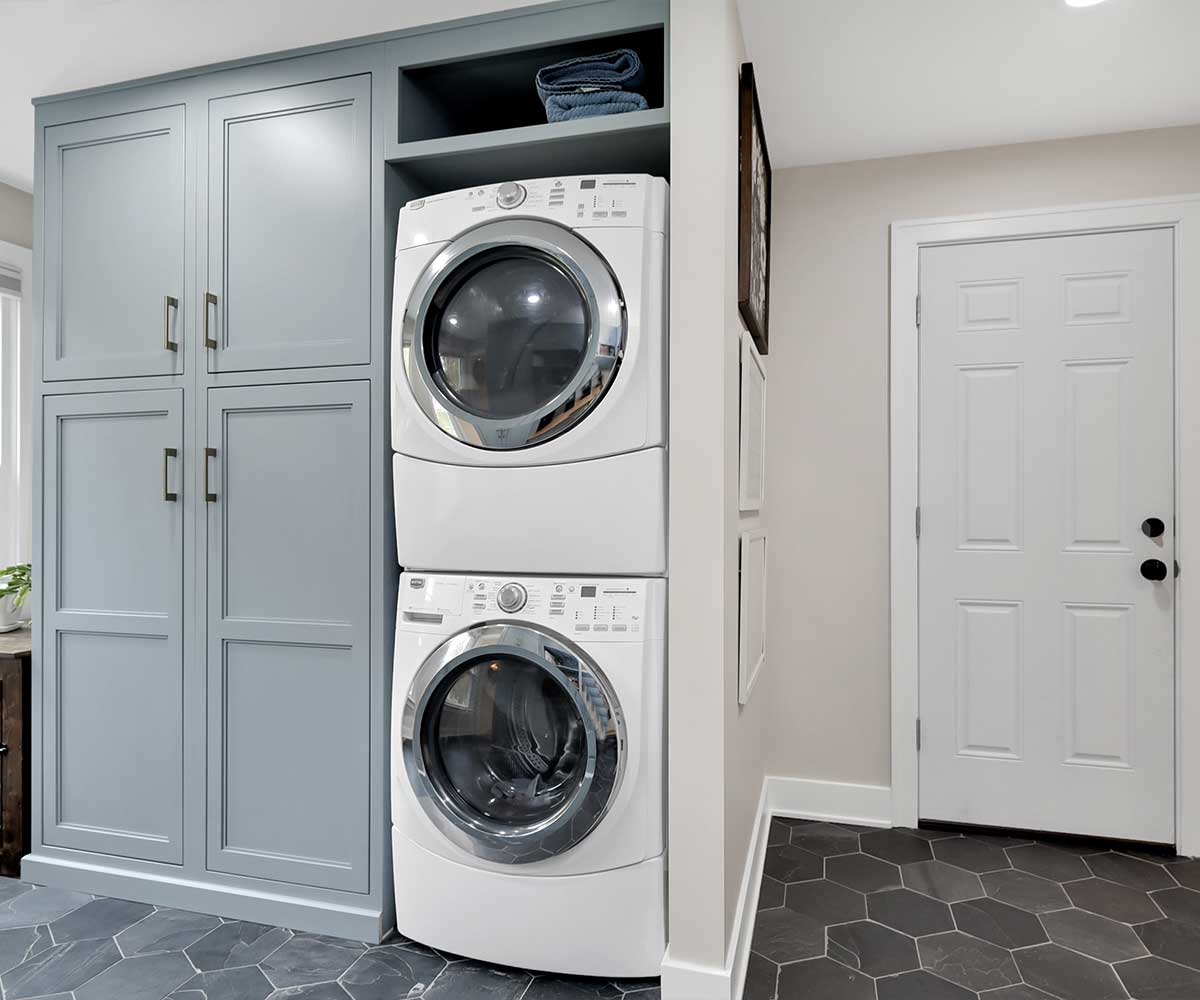
This is where the style pays for itself. A laundry room takes more abuse than anywhere else in the house, and a character finish on hickory or oak absorbs the evidence in a way a flat modern front never will. The first scratch is not a crisis. It also suits the way these rooms get built. Deep cupboards for bulky things, a run of drawers for the small ones, and no decoration anywhere to catch a basket corner or chip against a machine door.

View more →
Storage and Built-Ins 

Storage and Built-Ins 

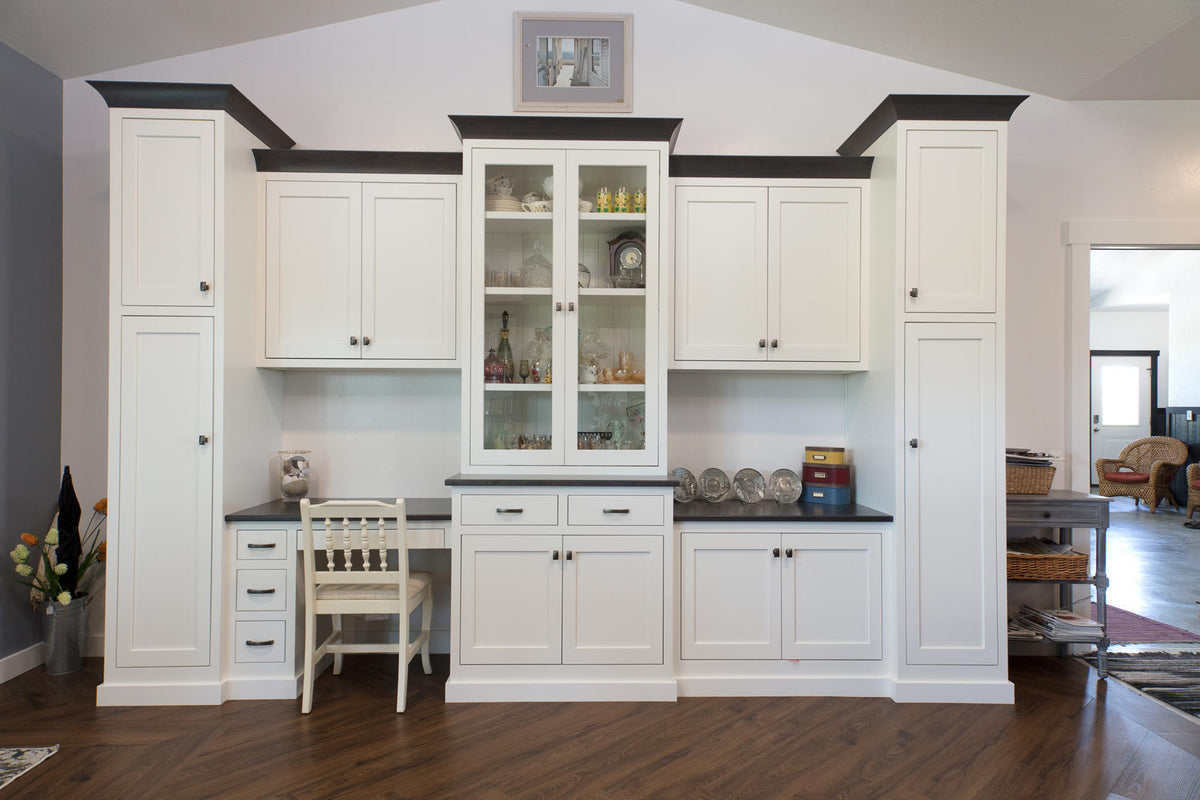
Farmhouse built-ins work best when they do not look built in. A pantry that reads as a standing cupboard, a mudroom bank that reads as a bench with a coat rail above it, a dining wall that reads as a hutch someone inherited. That is familiar ground for us. Our sister company has sold Amish and Mennonite furniture since 2017 and these cabinets come out of the same shops. Furniture proportions are an ordinary request here, so tell us the wall and what goes in it.

View more →

What Makes a Cabinet Farmhouse

Start with restraint at the door. Square edges, flat or simply panelled fronts, nothing carved and nothing applied, because the look depends on the cabinetry staying quiet enough for the wood and the metal to be heard. A shaker or a plain raised panel both get you there.

Then spend where the eye goes. In a kitchen that is the hood and the island. In a bath or a laundry it is the finish and the hardware doing the same job. Hickory and oak carry the most color variation of the species we build in, and a glaze over either settles into the grain and the corners rather than sitting on top.

 Every Cabinet Style We Build

Two separate choices, and farmhouse only answers one of them. The first four below decide how much frame shows once the doors are shut. The six after decide the shape of the door, and anything from the second list sits on anything from the first.  

Euro Cabinets

A frameless box, with doors that cover the carcass completely. 

 Inset Cabinets 

Doors fitted individually and set level inside their openings. 

 Face Frame Cabinets  

A hardwood frame across the front, and the base the next two are built on. 

 Partial Overlay Cabinets 

A half inch of door across the frame, with the rest of it on view. 

Full Overlay Cabinets 

Doors taken nearly to the frame edges, leaving a hairline between them.

 Shaker Cabinets 

Two stiles, two rails and a flat panel, with nothing else going on. 

 Raised Panel Cabinets 

A panel stepped above its frame, so the door catches light at the edges. 

 Rustic Cabinets 

Boards kept for their knots and streaks rather than sorted out of the run. 

 Traditional Cabinets 

Older American profiles, with worked edges and more weight to them. 

 French Cabinets 

Carving and curves, for a room that wants its woodwork looked at. 

Ready to Plan Your Farmhouse Cabinets?

Hoods and character grain are worth seeing in person, and both are standing in our Brentwood showroom. Can't get here? Send us the room and we will work it out together. Amish and Mennonite craftsmen in Ohio and Indiana make it; we fit it locally and ship it anywhere.
Book a Consultation

Frequently Asked Questions

Farmhouse describes the whole room rather than one door profile. Plain, solidly built fronts, wood with visible character, finishes with some depth to them, and a range hood doing most of the visual work. Shaker and plain raised panel are the usual doors.
Hickory and oak, because both carry real color swing from board to board and that variation is the point. Cherry works where you want something calmer that darkens over time. Brown maple is the one to pick if the kitchen is being painted.
No. White painted perimeters are common because they sit back and let the hood and the island lead, but a stained kitchen in hickory or oak is just as traditional. Many of the kitchens we draw use one of each, painted around the room and stained on the island.
Not strictly, though it is the element that makes the style read. There are 98 in our catalog, in straight, curved and shaped fronts, finished in metal patinas or in wood to match the doors. It is usually the first thing we settle.
Better than most. A glaze settles into the grain and the corners, so new marks land in a surface that already has variation in it. Solid hardwood is also repairable, which a wrapped panel is not, so a bad knock can be sanded and refinished in place.
Two to three weeks for stock, four to eight for semi-custom, eight to twelve for fully custom once the drawings are signed off. Hoods and furniture style built-ins sit at the custom end, so a farmhouse kitchen usually lands in that last bracket.
Species and finish first, then the pieces that are not cabinets: the hood, an island built to furniture proportions, any open or glazed sections. Those are what separate two farmhouse kitchens of the same size. We quote from the drawing.